
The Camera Turns On and Your Natural Self Disappears: Why We Freeze in Front of the Lens
Why being natural on camera feels so hard‚ and how a clear listener‚ eye contact with the lens‚ short takes and simple setup make it easier.
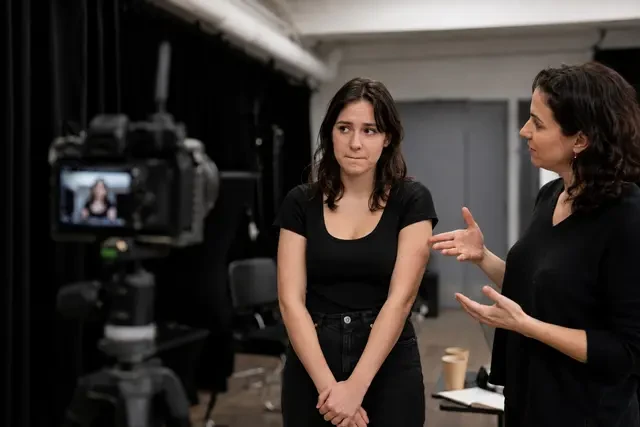
Practice in a setting such as an on-camera acting course for beginners lets you get to know the lens through short exercises and precise feedback‚ instead of waiting for an important moment to face it for the first time. The goal is not to erase every sign of nerves. It is to spend less attention on how we look and return to our intention: who we are talking to‚ what we want to convey and what is happening in the moment. The answer to awkwardness is not trying to push the camera out of your mind‚ but creating a familiar sequence of actions that reduces the number of decisions at the moment of recording. When the gaze‚ the frame‚ the text and the technical conditions are checked in advance‚ there is more room left for the conversation itself. You can then treat the lens as a point of contact rather than a mirror that scrutinizes every move.
The Absence of a Visible Listener
In an ordinary conversation‚ we receive small reactions: a nod‚ a smile‚ a question or a change of expression. In front of a lens‚ there is no face giving feedback‚ so speech can lose its address. Some people raise their energy and start to "perform"‚ while others shrink. In both cases‚ what is missing is a connection with an imagined or real person on the other side of the camera. Before filming‚ define one listener. Not "the audience"‚ but a specific person who needs the information. You can picture a familiar client‚ a student or a friend. The choice changes your language and pace. Instead of delivering a text into empty space‚ you are speaking to someone. The lens becomes a passage rather than a wall. Practice is more useful when it is short and repeated than when it is saved for a big event. Five minutes on a regular basis lets your body and mind get used to the situation‚ so that when it counts‚ less energy is needed just to get started.
The Gaze That Turns Back on Ourselves
A front camera shows your face in real time‚ and the eye is drawn to the image. This creates a situation where a person examines themselves instead of looking at the person in front of them. Even a slight shift of the gaze is noticeable on video. If you do not need to see the picture‚ you can hide the window after checking the frame and leave a small marker next to the lens. Watching the recording back also needs a framework. The first time‚ you can check only whether the message is clear‚ the second time the pace and the third time one technical detail. Watching in search of "what is wrong with me" is not practice. It deepens a general criticism that you cannot act on. Precise feedback refers to behavior you can change: pace‚ choice of example‚ focus of the gaze or the order of actions. A general remark about talent or confidence gives no direction and can turn the experience into a personality test.
The Body Inside a Small Frame
The camera crops the body and leaves part of it outside the frame. When the hands are not visible or the chair is too low‚ it can feel unnatural. Choose a frame that shows the upper body and leaves a little space above the head. That way you can use gestures without them disappearing at the edge of the screen. Stability is not stiffness. Both feet on the floor‚ easy breathing and relaxed shoulders give you a base. You can move a little‚ lean forward at an important point and change your expression. The goal is not to sit "correctly"‚ but to let the body take part without fighting the chair and the frame. It also helps to distinguish between discomfort and a poor fit. A slight sense of effort may indicate learning‚ while constant overwhelm calls for making the task smaller or changing the framework and the pace.
Written Text Versus Live Speech
Text that suits reading does not always suit speaking. Long sentences‚ abstract words and many parentheses sound heavier out loud. It is better to write bullet points rather than full paragraphs and then express the idea in natural words. If the wording must be precise‚ you can split the text into short sentences and leave room to breathe. A teleprompter can help‚ but it does not solve a lack of connection. Reading at a fixed pace with the eyes moving from side to side looks distant. Even with text in front of your eyes‚ you need to know what each sentence means and who it is addressed to. Marking key words and pauses can bring the reading back to life.
The Short Recording as a Training Tool
Effective practice does not require a ten-minute video. You can record a thirty-second answer to a single question. The first time‚ focus on the opening‚ the second time on the ending and the third time on the pace. A short clip lets you repeat without getting tired and see real change. It is best to change only one thing in each round. Trying to fix your voice‚ hands‚ gaze‚ words and background all at once creates overload and brings back the stiffness. Once one element becomes more natural‚ you can move on to the next. This way confidence is built on familiarity rather than general encouragement.
Technical Conditions That Reduce Pressure
Light coming from in front of the face‚ a camera at eye level and clear sound remove a large part of the awkwardness. When the picture is dark or the sound echoes‚ a person may interpret the result as a problem with their own presence. A short technical check separates the performance from the equipment. The background should also be calm‚ but not sterile. A tidy room with a little depth looks more natural than a white wall right behind you. Remove personal or distracting details and check that there is no strong light behind you. Once the setting is ready‚ stop changing it and turn your attention to the content.
A Five-Minute Preparation Routine
A short routine before filming can include checking light and sound‚ slow breathing‚ saying the first sentence out loud and recording a practice take that is not meant for publication. Stand or sit in the same position you will use for the shoot and mark a point next to the lens for your gaze to return to. After watching the practice take‚ choose just one correction‚ such as pace or volume‚ and do not open a list of criticisms about every detail. Repeating a fixed order teaches the body what is about to happen and shortens the time between pressing the button and speaking naturally.
In Summary
Awkwardness in front of a camera comes from a mix of self-awareness‚ the absence of a reaction‚ a physical frame and a text that is not always conversational. You can reduce it with a clear listener‚ looking into the lens‚ short practice sessions and simple technical conditions. Being natural on camera is not about trying to forget it exists‚ but about staying connected to your message even when it is there. Confidence is built from small repetitions‚ focused feedback and the ability to get back on track after a mistake. That way creativity remains a skill you can practice‚ not a trait you either have or lack.